
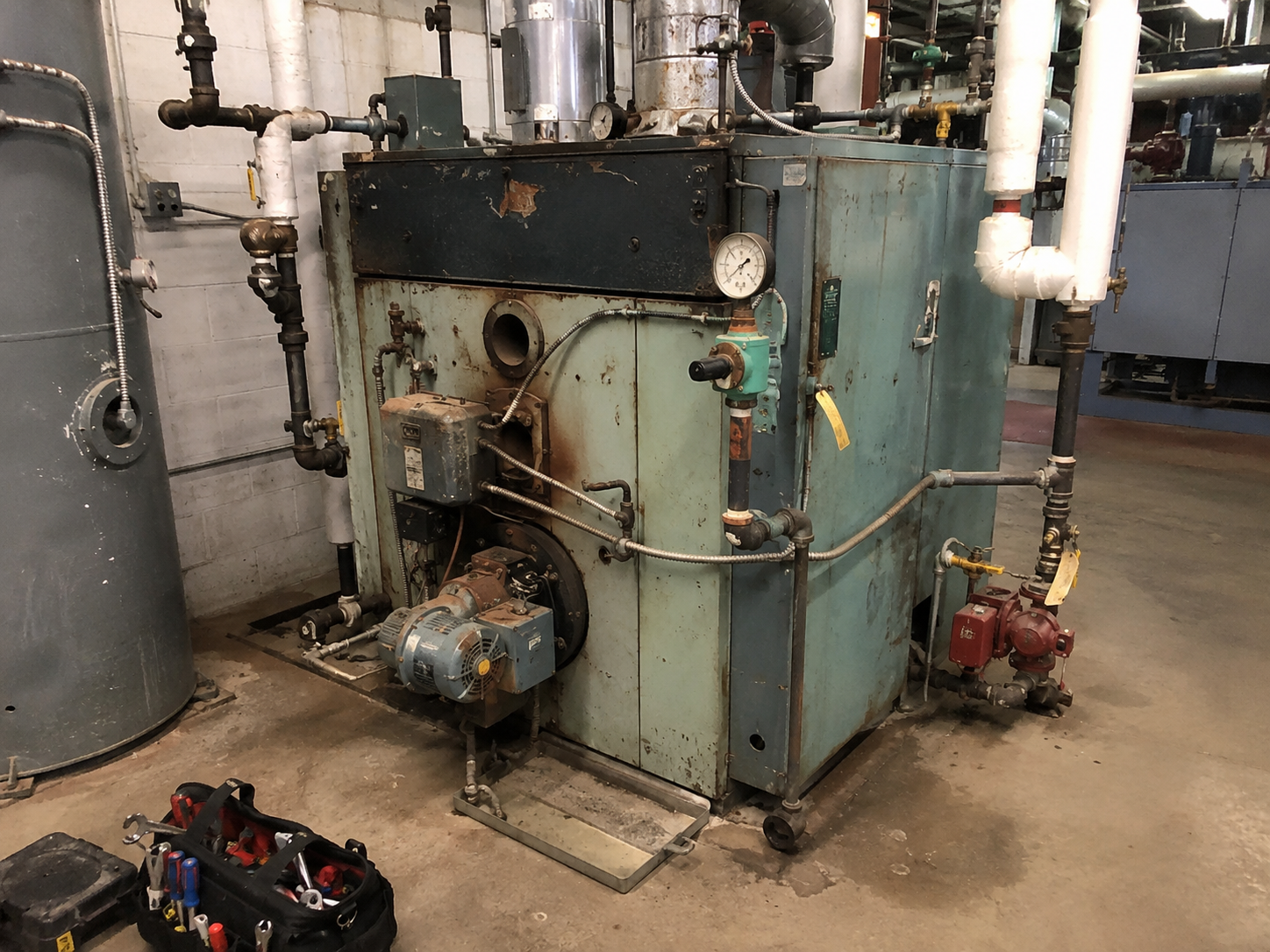
"It's still working." That's the most expensive sentence in commercial facility management.
An aging boiler that hasn't failed yet isn't a free pass — it's a clock. Every month a past-prime unit stays in service, the facility absorbs costs that don't show up as a single line item: higher fuel bills, more frequent service calls, parts sourced at premium pricing, and an increasing probability of a failure that happens on the worst possible day. The decision to delay boiler replacement isn't avoiding a cost. It's trading a known cost for a larger, unpredictable one.
Here's where those costs are accumulating right now.
Rising Repair Costs Add Up Fast
The repair history on an aging boiler tends to follow a pattern that's slow at first, then accelerates. A heat exchanger repair is one year. A control failure is next. A pressure relief valve replacement shortly after. Each individual repair seems manageable in isolation — but the cumulative spend over a 3–5 year stretch often surprises facility managers when they actually add it up.
Parts availability compounds the problem. Commercial boiler components for units manufactured 15–20 years ago are increasingly hard to source. When parts require special ordering or manufacturer-direct sourcing, lead times stretch and pricing climbs. A repair that cost $2,500 in parts three years ago may cost $4,500 today for the same component — if it's available at all.
There's also a labor dynamic worth understanding. Confined-space and high-pressure steam work on an older boiler takes longer than the same scope on a newer unit with better access and current fittings. That time difference shows up on every invoice.
The practical rule: if your repair history over the past 24 months on a single boiler adds up to more than 30–40% of the current replacement cost, you've already started paying for a new boiler. You just haven't gotten one yet.
Efficiency Losses You're Already Paying For
Modern commercial boilers operate at 90–96% thermal efficiency. A boiler manufactured 15–20 years ago, even when new, typically ran at 80–85%. After years of operation with accumulated scale, sediment, and component wear, that same unit is likely performing worse than its original rating.
The fuel cost difference between an 82% efficient boiler and a 94% efficient replacement isn't abstract. On a facility spending $40,000 annually on heating fuel, that efficiency gap costs $4,800–$6,400 per year in excess fuel consumption. Over five years, that's $24,000–$32,000 spent on fuel that a newer unit wouldn't have burned.
That figure doesn't require a catastrophic failure to materialize. It's already happening on every billing cycle. And unlike repair costs, efficiency losses don't show up as a line item anyone reviews — they're embedded in utility bills that most facilities treat as a fixed cost of operation.
A licensed mechanical contractor can help you calculate your current unit's actual operating efficiency and model what replacement would mean for your annual fuel spend. That number, set against replacement cost, often changes the conversation.
The Risk of an Emergency Failure
A commercial boiler that fails in January in Minnesota is not a mechanical problem — it's an operational crisis. Tenants are cold. Production is down. The decisions that should have been made in October are now being made at 9 pm on a Friday with limited contractor availability and no time to evaluate options properly.
Emergency boiler replacement in the Twin Cities metro carries real cost premiums: expedited equipment sourcing, priority scheduling, after-hours labor rates, and the possibility that the unit most readily available isn't the best fit for your system. Facilities that plan replacements in the off-season — spring through early fall — get better equipment selection, competitive pricing, and work scheduled on their terms.
The other risk is more serious than cost. A boiler operating past its reliable service life is operating with increased probability of a pressure failure, a control malfunction, or a combustion issue. The consequences of those failures aren't limited to downtime and repair bills. They include personnel safety, regulatory investigation, and insurance claims that affect coverage going forward.
Compliance and Insurance Exposure
Minnesota's commercial boiler inspection program requires periodic state inspections of pressure vessels and high-pressure steam systems. An aging boiler that passes inspection today may not pass next year — and a unit condemned during inspection leaves the facility with no transition time and no leverage on pricing or scheduling.
Insurance carriers are increasingly attentive to the age and condition of mechanical systems in commercial buildings. A boiler operating well past its expected service life is a documented risk factor. Facilities that have deferred replacement are sometimes surprised to find that their carrier's position on a claim is complicated by evidence that the system was past its useful life at the time of the incident.
Proactive replacement, with proper permitting and licensed contractor documentation, creates a clear record of compliance. That documentation matters both for state inspectors and for the insurance conversation.
When the Numbers Favor Replacement
The repair-vs.-replace calculation isn't complicated once you have the right inputs. Replacement typically makes financial sense when any of the following are true:
The unit is 20+ years old
A single repair exceeds 50% of the current replacement cost
Cumulative repairs over 24 months exceed 30–40% of replacement cost
Current operating efficiency is below 85%
The unit has been flagged for any compliance issues during inspection
Parts availability has become a recurring sourcing challenge
If two or more of those conditions apply to your current boiler, the financial case for continued deferral is difficult to construct honestly. You're not avoiding replacement cost — you're paying it in installments while adding operational risk on top.
The better question isn't whether to replace. It's whether to replace on your schedule or on the boiler's schedule.
Plan the Work Before Winter Forces It
KO Mechanical Services installs commercial boilers across the Twin Cities metro — from equipment removal and new unit installation to piping connections and system integration. We also handle mechanical room modifications when a replacement is the right moment to address the surrounding infrastructure.
Commercial boiler installation scheduled before heating season means better pricing, better equipment selection, and work done without the pressure of a facility that's already cold.
KO Mechanical Services:
Phone: (651) 380-8108 Email: Contact@komechmn.com