ASME B31.1 vs. B31.3: Which Piping Code Applies to Your Facility?
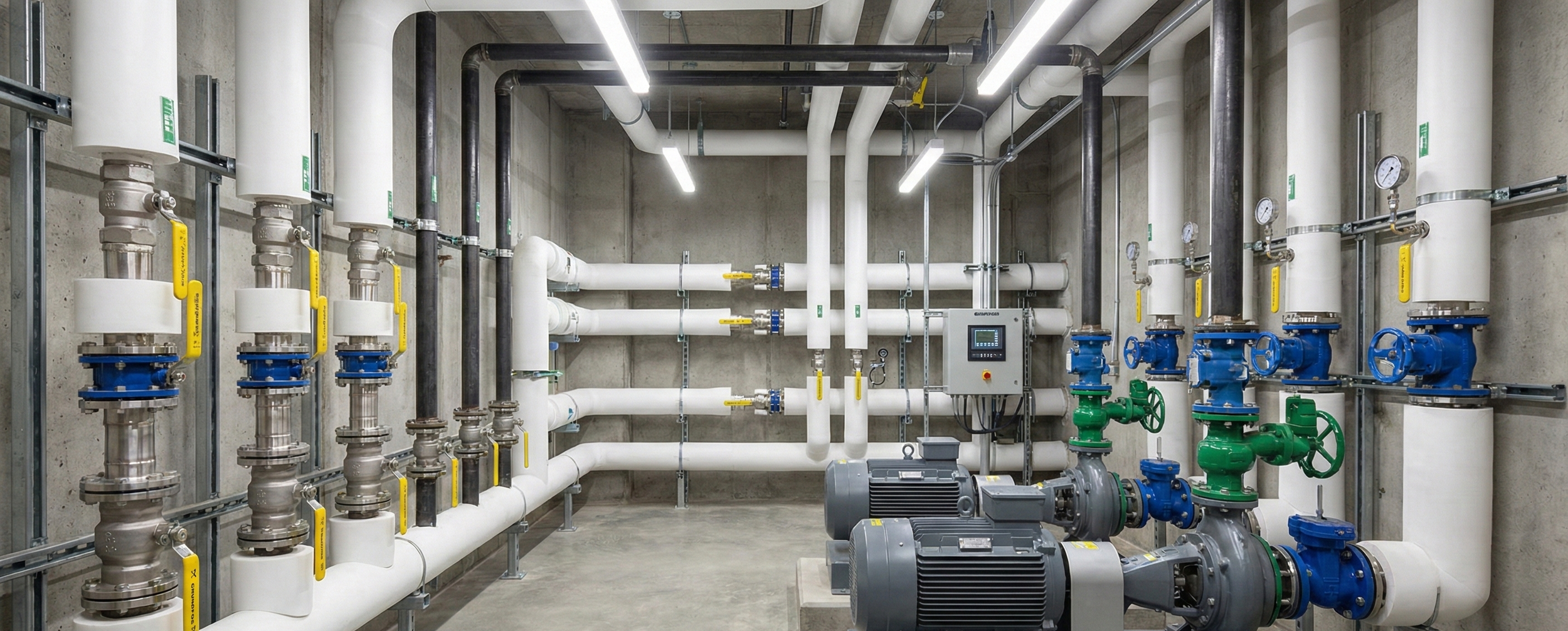
If you manage a commercial or industrial facility in Minnesota with steam, process, or high-pressure piping, you've likely encountered the terms B31.1 and B31.3. They're both ASME pressure piping codes. They're both required on real projects. And they're frequently confused — including by contractors who should know better.
This post explains the practical difference between the two codes, which one applies to your facility's piping systems, and why getting that answer wrong creates real problems during inspections and project closeout.
What ASME B31 Is and Why It Exists
The ASME B31 Code for Pressure Piping is a family of standards published by the American Society of Mechanical Engineers. Each volume in the B31 series governs a specific category of piping — power piping, process piping, building services piping, gas transmission piping, and others.
The two codes most relevant to commercial and industrial facilities in the Twin Cities are:
ASME B31.1 — Power Piping
ASME B31.3 — Process Piping
They are not interchangeable. They govern different systems, impose different design requirements, and in many cases require different welding qualifications and documentation. A contractor who quotes "ASME-compliant work" without specifying which code is giving you an incomplete answer.
ASME B31.1: Power Piping
B31.1 governs piping systems that generate, distribute, or use steam or high-temperature/high-pressure fluids in what the code calls "power service." In practical terms for a Twin Cities facility, B31.1 typically applies to:
Steam distribution piping — from boilers to steam headers, steam mains, and distribution lines
High-pressure steam systems — including any piping operating above 15 psig steam pressure
Boiler external piping — the piping directly connected to a boiler, from the boiler nozzles to the first isolation valve
Condensate return systems — particularly on high-pressure steam systems
Hot water heating systems operating above specific temperature and pressure thresholds
Feedwater piping on larger steam systems
In Minnesota, B31.1 work overlaps directly with the state's High-Pressure Piping (HHP) regulations. Projects involving high-pressure steam or power piping require a contractor holding the Minnesota High-Pressure Piping Contractor License (HC802574) — and the welding performed on those systems must meet B31.1's specific qualification requirements.
The welding requirements under B31.1 are stringent. Weld procedures must be qualified, welders must be performance-qualified to those procedures, and documentation — Welding Procedure Specifications (WPS), Procedure Qualification Records (PQR), and Welder Performance Qualifications (WPQ) — must be on file and available for inspection. This is exactly what ASME Section IX certified welding programs are designed to provide.
ASME B31.3: Process Piping
B31.3 governs piping found in petroleum refineries, chemical plants, pharmaceutical facilities, food and beverage processing operations, and similar industrial environments. If your facility manufactures, processes, or handles chemical, biological, or food-grade fluids through a piped system, B31.3 is almost certainly the governing code.
In practice, B31.3 typically applies to:
Chemical process piping — any piping conveying chemical feedstocks, reaction products, or process fluids
Food and beverage process piping — including sanitary stainless systems in breweries, dairy operations, and food processors
Pharmaceutical and biotech piping — high-purity systems, clean steam, WFI (water for injection) systems
Wastewater treatment process piping — process lines within treatment plants (distinct from building plumbing)
Industrial gas distribution piping — compressed air, nitrogen, specialty gases at process pressure
Cooling water and process fluid systems in manufacturing environments
B31.3 also addresses a broader range of materials and joining methods than B31.1, reflecting the diversity of fluids and operating conditions found in process environments. Its requirements for examination, testing, and documentation vary based on the "fluid service" category — normal fluid service, category D (low-risk), category M (highly hazardous), and high-pressure fluid service each carry different requirements.
Where B31.1 and B31.3 Overlap — and Where They Don't
The most common source of confusion is a facility that has both power piping and process piping — which describes most large manufacturing plants, hospitals, food processors, and institutional campuses in the Twin Cities.
A typical food processing facility, for example, might have:
High-pressure steam lines supplying process heat → B31.1
Stainless process piping carrying product through the manufacturing line → B31.3
Low-pressure steam used directly in process (culinary steam) → potentially both, depending on configuration
Each system requires the contractor to work to the correct code. A contractor qualified under one code is not automatically qualified to perform work under the other. The weld procedure qualifications, inspection requirements, and documentation packages are code-specific.
This is a practical reason why working with a single mechanical contractor who holds both capabilities — ASME Section IX welding qualifications applicable to both B31.1 and B31.3 scopes, and the Minnesota High-Pressure Piping License for regulated steam work — simplifies project execution considerably. One sub, one set of documentation, no scope gaps at the handoff between power and process systems.
What Minnesota's Regulatory Layer Adds
Minnesota's Department of Labor and Industry enforces state-level rules on top of the ASME codes for certain piping categories. High-pressure steam piping, in particular, is subject to state inspection under Minnesota's High-Pressure Piping statute — not just the ASME code itself.
This means that B31.1 work on high-pressure steam systems in Minnesota requires:
A contractor licensed by the state as a High-Pressure Piping contractor (License HC802574 is KO Mechanical's state license for this scope)
Welding performed to ASME Section IX qualified procedures
State inspection and sign-off before the system is placed in service
Facilities that hire unlicensed contractors for this scope don't just risk a failed inspection — they risk operating a system the state hasn't approved, which carries liability exposure beyond the construction project itself.
For B31.3 process piping, the licensing requirements vary based on the fluid service and the city in which the facility operates. Municipal licenses for gas, steam, and refrigeration work in Minneapolis and Saint Paul add another layer of jurisdiction that out-of-area contractors often aren't set up to navigate.
Practical Guidance: Which Code Applies to Your Project?
Use this as a starting framework — your mechanical contractor should confirm the applicable code based on your specific system parameters:
System TypeLikely Governing CodeHigh-pressure steam (above 15 psig)ASME B31.1Boiler external pipingASME B31.1Low-pressure steam (15 psig and below)ASME B31.1 or building codeHot water heating above 250°FASME B31.1Chemical process pipingASME B31.3Food/beverage process pipingASME B31.3Wastewater treatment process linesASME B31.3Compressed air (industrial process)ASME B31.3Pharmaceutical / clean steamASME B31.3Utility water and building HVAC pipingBuilding code / ASME B31.9
When a project involves both B31.1 and B31.3 scopes — common in manufacturing, healthcare, and institutional facilities — the contractor needs to track and document each system separately under the correct code.
Getting the Code Right from the Start
Misapplying a piping code isn't a paperwork problem — it's a project execution problem. Weld procedures qualified to the wrong code have to be redone. Inspection packages built to the wrong documentation requirements get rejected. In the worst cases, systems have to be pressure-tested and re-examined after the fact.
The contractors who get this right aren't the ones who know the most about ASME codes in the abstract. They're the ones who have built ASME Section IX welding programs, maintained current procedure qualifications across both B31.1 and B31.3 scopes, and have enough field experience with Minnesota's inspection process to know where the friction points are.
For more on what to look for when evaluating a contractor's pressure piping qualifications, see our earlier post on high-pressure piping qualifications and what Minnesota facilities should require.
KO Mechanical Services holds the Minnesota Mechanical Contractor License (MB100229), the Minnesota High-Pressure Piping Contractor License (HC802574), and Master Steam and Hot Water, Master Gas Fitter, Master Refrigeration, and Master Oil Burner licenses in both Minneapolis and Saint Paul. Our ASME Section IX-certified welding program covers both power piping and process piping scopes, with full WPS, PQR, and WPQ documentation on file.
If you have a piping project and you're not sure which code applies — or you need a contractor who can work across both — we're a straightforward call.
KO Mechanical Services
Phone: (651) 380-8108
Email: Contact@komechmn.com
Website: komechmn.com
Minnesota Licenses: MB100229 | HC802574
Veteran-owned. Twin Cities metro.