
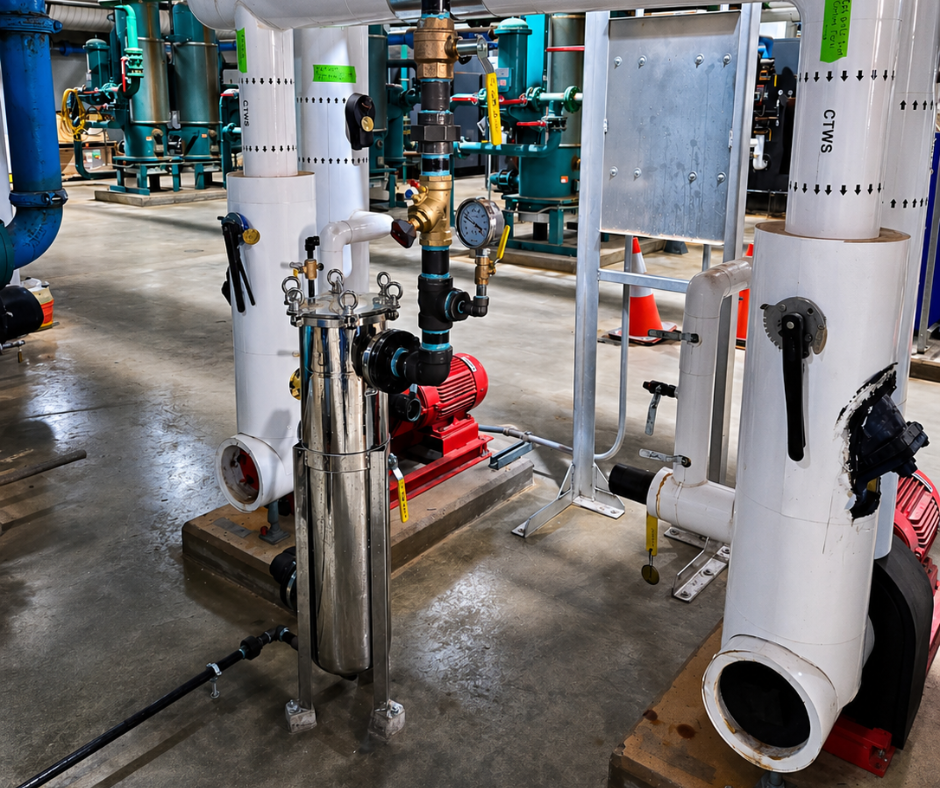
When most people think about mechanical contracting, they picture pipes already in place — running through walls, connecting equipment, carrying steam or water through a building. What they don't always see is the work that happens before a single pipe is installed: the fabrication.
Pipe fabrication is one of the most technically demanding parts of any commercial or industrial mechanical project. Done right, it sets the foundation for a system that performs reliably for decades. Done wrong, it creates problems that are expensive, dangerous, and difficult to fix after the fact.
At KO Mechanical, pipe fabrication is a core part of what we do — and it's work we take seriously. Here's what the process actually involves, and why the quality of your fabrication contractor matters more than most clients realize.
What Is Pipe Fabrication?
Pipe fabrication is the process of cutting, shaping, joining, and assembling pipe sections and components into finished assemblies — called spools — that are ready for installation in a facility.
Rather than fitting pipes together piece by piece in the field, fabrication allows sections of a piping system to be precision-built in a controlled environment first. These spools are then transported to the jobsite and installed as complete units.
Fabrication work typically includes:
Cutting pipe to precise lengths using specialized equipment such as orbital cutting machines
Beveling and facing pipe ends to prepare them for welding
Fitting and aligning components including elbows, tees, reducers, flanges, and valves
Welding joints using the appropriate process for the material and application — TIG, MIG, or stick welding depending on the pipe type and pressure rating
Inspection and testing to verify weld quality and dimensional accuracy before installation
The result is a ready-to-install assembly that meets exact project specifications and applicable codes.
Why Pipe Fabrication Requires Specialized Expertise
Not every mechanical contractor is equipped — or qualified — to handle pipe fabrication for commercial and industrial applications. Here's why the expertise of your fabrication team matters:
Material Knowledge
Different applications require different pipe materials. Carbon steel, stainless steel, alloy pipe, and specialty materials each have different properties, welding requirements, and code considerations. A fabricator needs to understand how each material behaves during cutting, heating, and welding — and how to achieve the right result for each application.
KO Mechanical works with carbon steel, stainless steel, and specialty materials across a wide range of commercial and industrial applications, including steam, process, high-pressure, and gas distribution systems.
Welding Certification
For high-pressure and code-regulated applications, welding isn't just a skill — it's a qualification. KO Mechanical holds an ASME Section IX Certified Welding Program, which means our welders are tested, documented, and qualified to perform welds that meet the American Society of Mechanical Engineers' strict performance standards.
This certification is particularly important for steam, high-pressure process piping, and pressure vessel applications, where weld integrity is critical to safe operation.
Precision and Tolerances
Commercial and industrial piping systems are engineered to tight tolerances. A spool that's off by even a fraction of an inch can create alignment problems during installation, stress on fittings and supports, and potential for leaks or failures under pressure. Precision fabrication — backed by quality control at every step — is what ensures your system installs cleanly and performs as designed.
The Role of Pipe Fabrication in Large-Scale Industrial Projects
For large commercial and industrial projects, off-site pipe fabrication offers significant advantages over field fabrication:
Efficiency: Fabricating spools in a controlled environment is faster and more efficient than doing the same work in the field, where space, access, and conditions are often more challenging.
Quality Control: Shop fabrication allows for better inspection and quality verification before components reach the jobsite. Problems are easier to identify and correct before installation.
Safety: Reducing the amount of welding and fitting work performed at elevation or in confined spaces improves jobsite safety for everyone involved.
Schedule: Pre-fabricated spools can be delivered to the site ready to install, reducing overall project duration and minimizing disruption to facility operations.
KO Mechanical has applied these advantages on projects ranging from commercial building mechanical systems to large-scale industrial installations, including work at the Metropolitan Council Metro Plant (Pigs Eye) — one of the largest wastewater treatment facilities in Minnesota.
What to Look for in a Pipe Fabrication Contractor
If you're evaluating mechanical contractors for a project that includes pipe fabrication, here are the key qualifications to verify:
Licensing: In Minnesota, high-pressure piping work requires a licensed contractor. KO Mechanical holds Minnesota High-Pressure Piping Contractor License #HC802574 and Minnesota Mechanical Contractor License #MB100229, covering the full scope of commercial and industrial mechanical work.
Welding Certification: Ask for documentation of the contractor's welding program. An ASME Section IX certification means welders have been formally qualified — not just experienced.
Equipment: Precision fabrication requires specialized tooling. KO Mechanical uses professional-grade equipment including orbital pipe cutting and facing machines to achieve the precise end prep required for high-quality welds.
Experience: Fabrication for steam, high-pressure, and process piping applications is more demanding than standard mechanical work. Look for a contractor with documented experience in your specific type of system.
References and Past Projects: A reputable fabrication contractor should be able to point to completed projects of similar scope and complexity.
KO Mechanical's Pipe Fabrication Capabilities
KO Mechanical Services provides pipe fabrication for commercial and industrial projects throughout the Minneapolis/St. Paul metro area and greater Minnesota. Our capabilities include:
Carbon steel, stainless steel, and specialty material fabrication
ASME Section IX certified welding — TIG, MIG, and stick processes
Orbital pipe cutting and precision end facing
Spool fabrication for steam, hot water, chilled water, process, and high-pressure systems
Gas distribution piping fabrication
Complete installation of fabricated assemblies by our licensed master pipefitters
We're a veteran-owned business with over 12 years of experience delivering quality mechanical work for clients who depend on systems that perform.
Ready to Talk About Your Project?
Whether you're planning a new industrial installation, a mechanical room upgrade, or a complex process piping system, KO Mechanical has the fabrication expertise and licensing to get it done right.